Tired of 30-minute manual IBC tote cleaning that misses the corners? Discover how an electric 3D rotating cleaning system cuts cleaning time to 3 minutes, uses 80% less water, and delivers 100% coverage — zero confined space entry required.
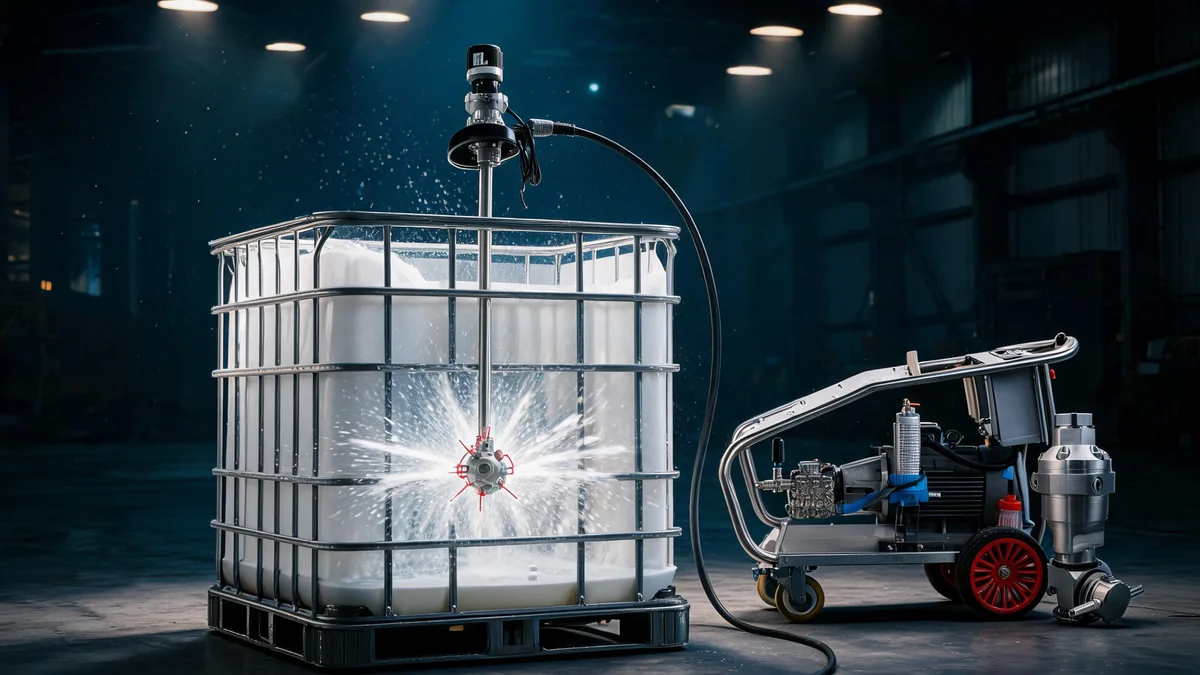
Say Goodbye to Manual IBC Tote Cleaning:
This Electric 3D System Boosts Efficiency by 10x
From 30 minutes of backbreaking scrubbing to 3 minutes of fully automated cleaning — discover how an electric 3D rotating nozzle system is revolutionizing IBC tote cleaning in warehouses, plants, and facilities worldwide.
Here's a number that will make any operations manager stop and think: cleaning a single IBC tote manually takes 30 minutes on average. With an electric 3D rotating cleaning system? 3 minutes. That's a 10x efficiency improvement — and the results are actually better too.
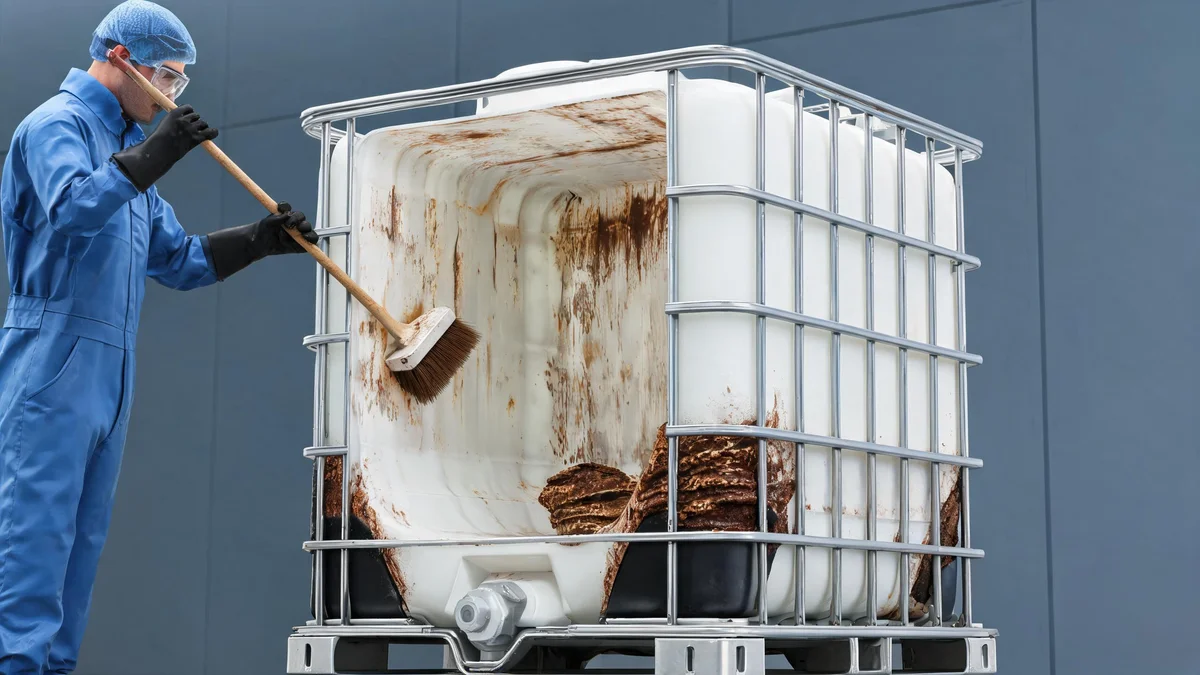
If you work with Intermediate Bulk Containers (IBCs), you know the drill. A worker climbs a ladder, lowers a brush through the 150mm top opening, and scrubs away at walls they can barely see. Thirty minutes later, the tote looks clean — but the corners, seams, and bottom sump still harbor residue. It's slow, it's wasteful, and it's inconsistent.
What if there was a better way? In this article, I'll break down exactly why manual IBC cleaning falls short, and how an electric 3D rotating cleaning system can transform your tote cleaning operation — delivering 10x faster results, 80% less water usage, zero confined space entry, and consistent, verifiable quality every single time.
The IBC Tote Cleaning Challenge: What Are We Really Up Against?
Before we dive into solutions, let's understand the full scope of the problem. IBC tote cleaning isn't just one problem — it's a combination of physical constraints, residue types, safety concerns, and efficiency pressures that make it uniquely challenging.
| Challenge | Description | Impact | Severity |
|---|---|---|---|
| Limited Access | Standard IBCs have only a 150mm top opening and a bottom valve — far too small for a person to enter safely | Manual cleaning only reaches what a brush can reach from the opening | ★★★★★ |
| Dead Corners | Rectangular shape with internal baffles creates corners and seams where residue accumulates | Hidden buildup that breeds bacteria and contaminates new batches | ★★★★★ |
| Residue Variety | Liquids range from viscous oils and syrups to fine powders and aggressive chemicals | One cleaning method doesn't work for all residue types | ★★★★☆ |
| Safety Risks | Confined space entry, chemical exposure, slippery surfaces, falling hazards | Worker injury risk, regulatory compliance issues | ★★★★☆ |
| Water Waste | Manual rinsing uses enormous volumes of water, much of it wasted | High water bills, wastewater treatment costs | ★★★☆☆ |
| Time Consumption | A single thorough manual clean can take 30-60 minutes per tote | Bottleneck in production/reuse cycles | ★★★★☆ |
What makes this problem so frustrating is that none of these challenges are new — and yet many operations are still using the same manual methods they used 30 years ago. Workers climb ladders, lower themselves partway into the opening, and scrub away at walls they can barely see. The result? Totes that look clean on the surface but harbor residue in the corners, along the seams, and at the bottom where the brush can't reach.
In facilities that rely on manual IBC cleaning, I've consistently found that 40-60% of totes fail visual inspection after a "thorough" clean. The problem isn't worker effort — it's that the human arm, even with a 2-meter brush, simply can't reach every surface inside a 1200mm x 1000mm x 1150mm IBC tank through a 150mm opening. It's a geometry problem, not a work ethic problem.
Why Is IBC Tote Cleaning So Difficult? The Anatomy of the Problem
To understand why 3D nozzles are such a breakthrough, we first need to understand exactly what makes IBC cleaning so stubborn. Let's break it down by the numbers and the physics.
The Geometry Problem
A standard IBC tote has internal dimensions of roughly 1160mm × 960mm × 1050mm (L × W × H), with a top opening of only 150mm in diameter. That's like trying to clean a walk-in closet through a mail slot. A worker standing above can lower a brush straight down, but reaching the side walls — especially the far wall and the bottom corners — is physically impossible without entering the tank.
The Four Unreachable Zones:
- Bottom Corners The four bottom corners where the floor meets the side walls are the #1 trouble spot. Residue settles here, dries, and cakes on. A brush coming straight down simply cannot reach the horizontal floor at the corner junction.
- Underside of the Top Baffle Many IBCs have a baffle ring just below the top opening. The underside of this ring is nearly impossible to clean from above — spray and brush strokes glance off without making proper contact.
- Far Side Wall The wall opposite the cleaning position receives only glancing blows from angled spray wands. It's the last to get clean and the first to show streaks.
- Bottom Valve Sump The area around the discharge valve at the bottom has a recessed sump where heavy residue settles. It's also where mixed residue collects during the draining process.
The Residue Problem
Different contents create different cleaning challenges, and the wrong approach can make things worse:
| Residue Type | Characteristics | Cleaning Challenge | Common Industries |
|---|---|---|---|
| Viscous Liquids (oils, syrups, glues) | Thick, sticky, adheres to walls | Requires high-impact spray to dislodge; simple rinsing just spreads it | Food, chemical, adhesives |
| Dried/Caked-on | Hard, crusty, bonded to surface | Brushing alone is ineffective; needs sustained high-pressure impact | Paints, coatings, food concentrates |
| Powders & Fine Solids | Dusty, electrostatic, airborne | Wet cleaning turns it into paste; requires precise spray coverage | Pharmaceutical, chemical, food |
| Biofilm & Bacteria | Invisible but microbiologically active | Looks clean but fails swab tests; requires full-surface contact time | Food, beverage, pharma |
In food, beverage, and pharmaceutical operations, it's not enough for the tote to look clean — it must pass microbial swab testing and visual inspection. This is where manual cleaning fails most dramatically. A worker's brush may leave the main walls looking good, but the corners and seams harbor biofilm that causes cross-contamination between batches. FDA, GMP, and HACCP compliance demands 100% coverage, every time.
Traditional Cleaning Methods: Why They Fall Short
Let's look at the methods most operations use today, and why they simply cannot deliver consistent, thorough results.
| Method | How It Works | Coverage | Time per Tote | Water Usage | Limitations |
|---|---|---|---|---|---|
| Manual Brush Scrubbing | Worker uses long-handled brush through top opening | 40-60% | 30-60 min | High (100-200L) | Cannot reach corners; inconsistent quality; labor-intensive; safety risks |
| Handheld Pressure Wand | Worker directs pressure washer spray from above | 50-70% | 20-40 min | Very high (200-400L) | Still can't reach all angles; significant overspray; operator fatigue |
| Tipping & Rinsing | Tote is tipped and filled/drained repeatedly | 30-50% | 15-30 min | Extremely high (300-500L) | Only washes loose debris; caked-on residue untouched; heavy equipment needed |
| Immersion Soaking | Tote filled with cleaning solution and left to soak | 80-90% | 2-8 hours | Very high | Very slow; uses massive amounts of water/chemical; still needs final rinse |
| 3D Rotating Nozzle | Automated 360° rotating spray head lowered into tote | 95-100% | 3-8 min | Low (30-80L) | Requires initial equipment investment; needs compressed air or power |
The numbers speak for themselves. 3D rotating nozzles deliver the best coverage in the least time with the least water — but they're also the least commonly used method, largely because many operations aren't aware the technology exists, or assume it's too expensive.
What they don't calculate is the total cost of ownership: labor cost per tote, water and wastewater cost, chemical cost, rejected batches due to contamination, and worker injury risk. When you add those up, a 3D nozzle system typically pays for itself in months, not years.
3D Rotating Nozzle Technology: How It Works
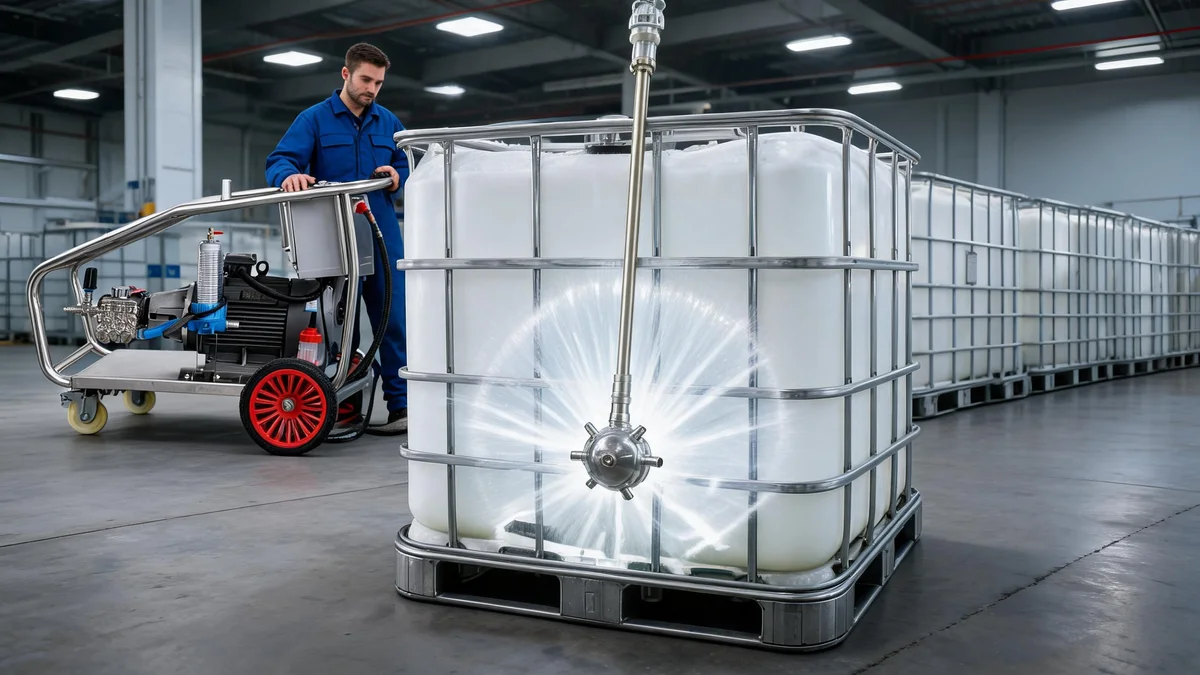
A 3D rotating cleaning nozzle (sometimes called a tank washing nozzle or CIP — Clean-In-Place — nozzle) is a precision device that uses fluid pressure (or an external drive) to spin a spray head in multiple axes simultaneously. The result is a 360° × 360° spray pattern that hits every interior surface of the tank or tote with consistent, high-impact water jets.
The Core Principle: Two-Axis Rotation
Unlike a simple spinning nozzle that only rotates in one plane (like a garden sprinkler), a true 3D nozzle rotates in two perpendicular axes at the same time:
1. Azimuth Rotation (Horizontal Sweep)
The spray head spins around the vertical axis, sweeping the spray jets in a full horizontal circle around the interior of the tank. This ensures all side walls receive coverage.
2. Elevation Rotation (Vertical Sweep)
Simultaneously, the nozzle arm tilts up and down through a full vertical arc, sweeping from the top of the tank down to the bottom. This is what reaches the floor, the corners, and the underside of the top baffle.
When these two motions combine, the spray traces a complex, overlapping geometric pattern across every square centimeter of the interior surface. Over a full cycle, no spot is missed — not the corners, not the seams, not the valve sump, not the baffle underside.
Key Advantages Over Manual Methods
100% Coverage, Every Time
The geometric spray pattern is consistent and repeatable. You don't depend on a worker's arm length or attention span. Every tote gets the same thorough clean.
Dramatically Faster
What takes 30-60 minutes manually takes 3-8 minutes with a 3D nozzle. For facilities cleaning 10+ totes per day, the time savings alone justify the investment.
Water & Chemical Savings
Because every drop is targeted and impactful, 3D nozzles use 50-80% less water than manual methods. That also means 50-80% less chemical, and 50-80% less wastewater to treat.
No Confined Space Entry
The nozzle is simply lowered through the top opening. No worker needs to enter the tank. This eliminates confined space entry permits, fall risks, and chemical exposure concerns.
Consistent Quality & Documentation
Automated cycles are reproducible. For regulated industries (food, pharma, chemical), this means consistent cleaning validation and easier audit compliance.
Electric 3D Rotating Nozzle: The Heart of 10x Faster IBC Cleaning
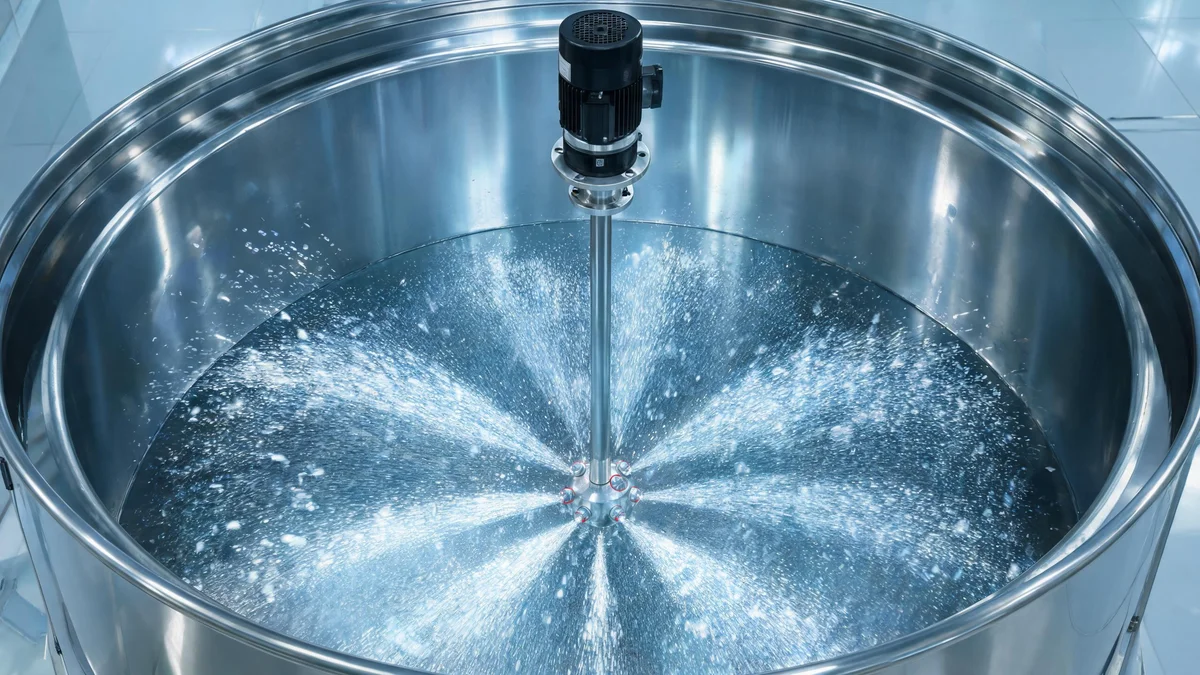
How It Works
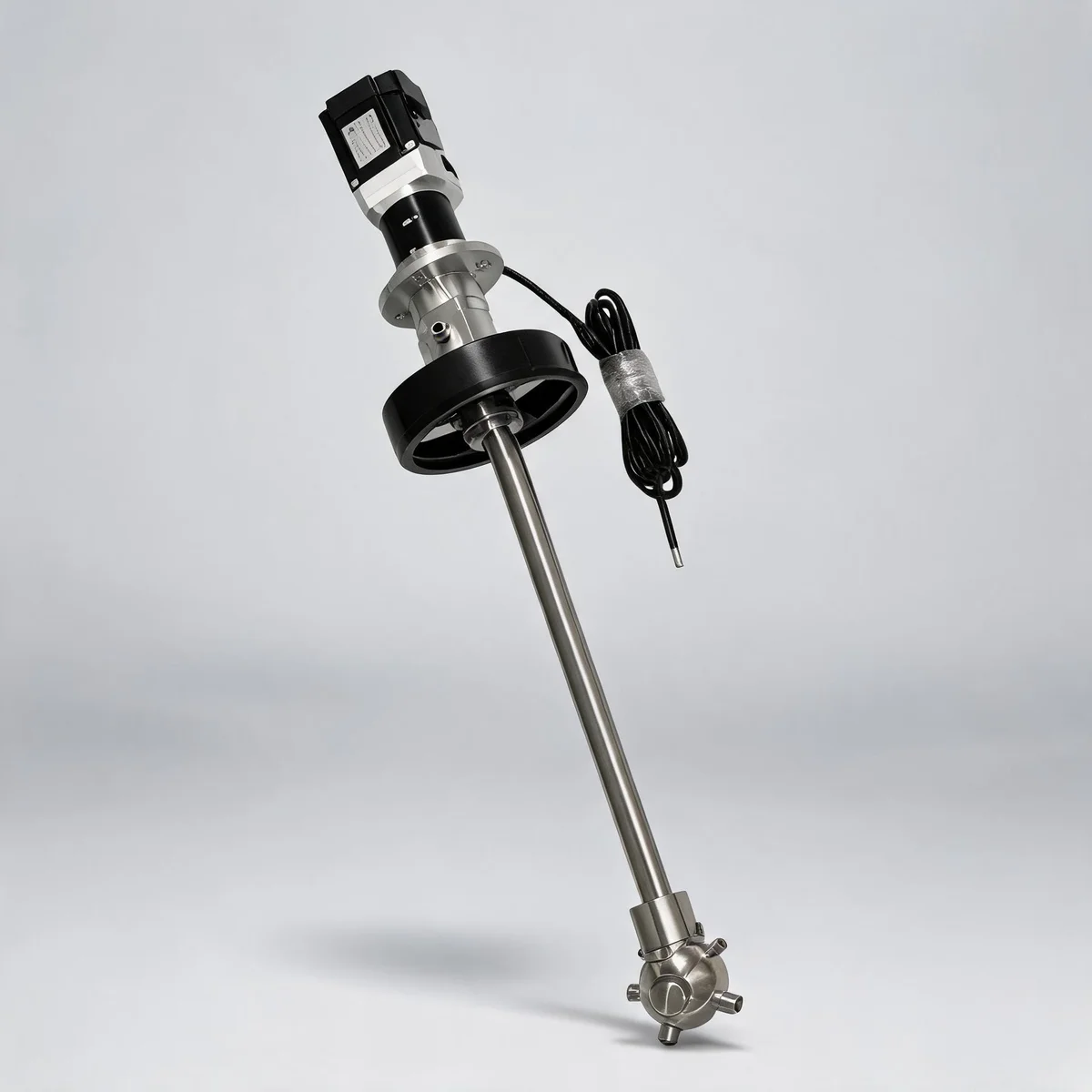
The electric 3D nozzle uses an electric motor to drive the rotation mechanism, with power delivered through an integrated cable. The motor connects to a precision gearbox that controls both the azimuth (horizontal) and elevation (vertical) rotation of the spray head.
Because the motor speed is electrically controlled, the rotation speed is highly consistent and unaffected by water pressure fluctuations or temperature changes. This means every cleaning cycle is identical — perfect for validated processes in pharmaceutical and food manufacturing.
The electric model is available in two configurations: a 220V AC version (400W) with adjustable speed reducer for industrial installations, and a 24V DC version (60W) for low-voltage safety applications or portable setups. Both deliver the same full-coverage cleaning performance.
The compact design fits through small-diameter tank openings (minimum entry diameter: 63mm), and the all-stainless steel construction (304/316) meets hygienic requirements for food, beverage, and pharmaceutical applications. The 10-meter power cable gives flexibility for positioning and installation.
Core Design Advantages
| Design Feature | Engineering Value |
|---|---|
| Electric Motor Drive | Precise, consistent rotation speed; unaffected by water pressure or temperature; easy speed adjustment |
| Full-Trajectory Coverage | Complete 360° multi-axis spray pattern delivers water-saving high-pressure cleaning with excellent performance |
| Compact Size for Small Openings | Fits small-diameter tank openings; rotation speed unaffected by water temperature |
| 304/316 Stainless Steel Body | Hygienic, corrosion-resistant, suitable for food, beverage, pharmaceutical, and chemical industries |
| Adjustable Speed Reducer | AC and DC options available with speed regulation for precise process control |
| 10m Power Cable | Generous cable length provides installation flexibility; suitable for various tank heights and positions |
Technical Specifications
| Parameter | Specification |
|---|---|
| Working Pressure | 3-18 MPa |
| Maximum Pressure | 20 MPa |
| Flow Rate | 15-84 L/min |
| Working Temperature | 0-90 °C |
| Weight | 6.52 kg |
| Inlet Connection Size | G3/8 |
| Nozzle Connection | 1/4" NPT (2 or 4) |
| Maximum Cleaning Diameter | 1-2 m |
| Electric Motor | 400W-220V AC-1.3A adjustable speed reducer / 60W-24V DC-5.8A adjustable speed reducer |
| Power Supply | 20.99.290 - 230V / 20.99.291 - 220V / 20.99.293 - 110V |
| Power Cable Length | 10 m |
| Material | 304 or 316 stainless steel |
| Minimum Entry Diameter | 63 mm |
| Minimum Rotational Diameter | 107 mm |
Application Scenarios
The electric model is the best choice when process consistency and validation are critical — think pharmaceutical CIP, food processing, and any application where cleaning cycles must be documented and reproducible. It's also preferred when compressed air isn't readily available, or where you want a simpler, more portable setup. The lower weight (6.52 kg vs. 9.5 kg) also makes it easier to handle in portable cleaning operations.
Note: Standard tank nozzles come with dynamic seals made of FKM or EPDM. For use with cleaning agents or chemical additives incompatible with standard seals, consult technical personnel for alternative seal materials.
200bar Pneumatic 3D Nozzle: Power-Driven, Temperature-Resistant
How It Works
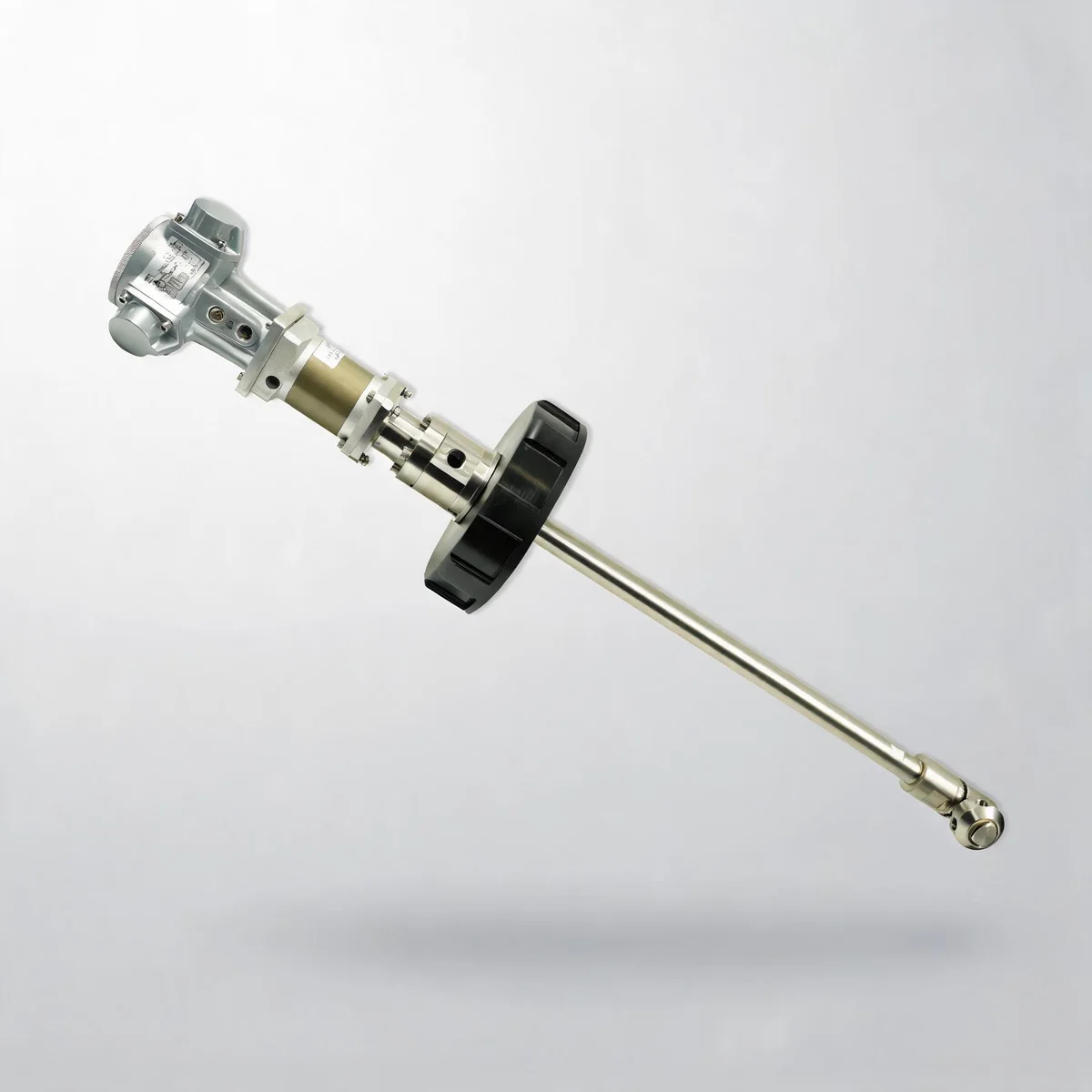
The pneumatic 3D nozzle uses compressed air to drive its rotation mechanism, separate from the high-pressure cleaning water. The air motor at the top of the unit spins the central shaft, which in turn drives the gear system that creates the two-axis rotation of the spray head.
This separation of drive force and cleaning fluid is a key design advantage: the rotation speed is controlled by the air pressure, not the water pressure. This means you can adjust the water pressure for different cleaning tasks — from gentle rinsing to heavy-duty descaling — without changing the rotation speed or spray pattern quality.
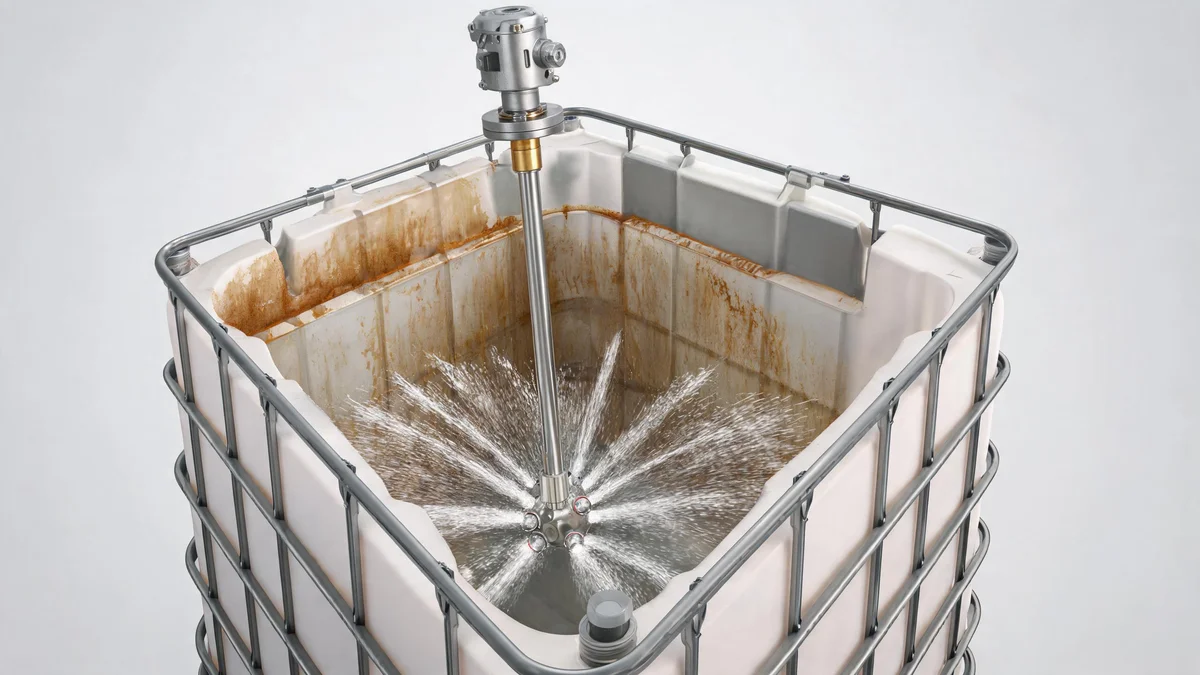
The spray head at the bottom is fitted with multiple precision nozzles (2 or 4, depending on configuration) that deliver focused high-pressure water jets. As the head rotates in both axes, these jets trace a complete coverage pattern across the entire interior surface of the IBC tote or tank.
The compact spray tower design fits through narrow tank openings — the minimum entry diameter is just 63mm, while the minimum rotational diameter is 100mm. This makes it compatible with standard IBC openings and most small-to-medium tank manways.
Core Design Advantages
| Design Feature | Engineering Value |
|---|---|
| Pneumatic Air Motor Drive | Stepless speed regulation via air pressure (≥2 bar); rotation speed unaffected by water temperature |
| Full-Coverage Spray Pattern | 360° multi-axis rotation ensures complete interior coverage, including dead corners and bottom seams |
| 304/316 Stainless Steel Construction | Corrosion resistant, suitable for food, beverage, pharmaceutical, and chemical sectors |
| Compact Spray Tower Design | Fits through narrow tank openings (min 63mm entry), works in tanks from 1-2m diameter |
| Water-Saving High-Pressure Cleaning | Targeted high-impact jets use significantly less water than manual methods |
| Temperature Resistant | Works reliably across 0-90°C water temperature range without performance change |
Technical Specifications
| Parameter | Specification |
|---|---|
| Working Pressure | 3-18 MPa |
| Maximum Pressure | 20 MPa |
| Flow Rate | 15-84 L/min |
| Working Temperature | 0-90 °C |
| Weight | 9.5 kg |
| Spindle Speed | Pneumatic air pressure ≥2 bar, stepless speed regulation |
| Inlet Connection Size | G3/8 |
| Nozzle Connection | 1/4" NPT (2 or 4) |
| Maximum Cleaning Diameter | 1-2 m |
| Material | 304 or 316 stainless steel |
| Minimum Entry Diameter | 63 mm |
| Minimum Rotational Diameter | 100 mm |
Application Scenarios
The pneumatic model is ideal for high-temperature cleaning operations (up to 90°C), such as food processing facilities that use hot water or steam cleaning. It's also preferred in explosive or hazardous environments where electric motors aren't suitable — the air-driven design is intrinsically safe. If your facility already has a compressed air system in place, this is often the most cost-effective choice.
Note: A pressure gauge and oil-water separator (dual component) must be added at the front of the pneumatic motor. Standard tank nozzles come with dynamic seals made of FKM or EPDM. For use with cleaning agents or chemical additives incompatible with standard seals, consult technical personnel for alternatives.
Pneumatic vs. Electric: Which 3D Nozzle Is Right for You?
Both the pneumatic and electric 3D nozzles deliver excellent cleaning performance. The right choice depends on your facility's infrastructure, application requirements, and operational priorities.
Pneumatic 3D Nozzle
- Best for high-temperature cleaning (0-90°C unaffected)
- Intrinsically safe for explosive/hazardous environments
- Ideal where compressed air is already available
- Stepless speed regulation via air pressure
- Heavier, more robust build (9.5 kg)
- Common in chemical, oil & gas, heavy industry
- Requires air compressor + oil-water separator
Electric 3D Nozzle
- Best for validated/consistent cleaning processes
- Precise speed control for repeatable cycles
- Ideal where compressed air is not available
- AC or DC power options available
- Lighter weight (6.52 kg) — easier to handle
- Common in pharma, food & beverage, biotech
- Simple plug-and-play electrical connection
For most IBC tote cleaning applications, both models will work well. The pneumatic model is the workhorse for heavy-duty industrial settings, while the electric model excels in precision-regulated environments. If you're still unsure, ask yourself: do I have compressed air readily available at the cleaning station? If yes, go pneumatic. If not, or if you need validated process consistency, go electric.
The Complete IBC Tote Cleaning System
A 3D nozzle is the heart of the system, but it works best when paired with the right high-pressure washer and accessories. Let's look at the complete portable IBC cleaning system.
High-Pressure Washer Units
The portable high-pressure washer provides the water pressure and flow that the 3D nozzle needs to do its job. Two models are commonly paired with these nozzles for IBC tote cleaning:
| Parameter | HS4020 | HS2930 |
|---|---|---|
| Pressure | 200 bar | 300 bar |
| Flow Rate | 40 L/min | 29 L/min |
| Motor Power | 15 kW | 18.5 kW |
The HS4020, with its higher flow rate (40 L/min), is the preferred match for most IBC cleaning applications — the higher volume means faster rinsing and more total cleaning power delivered to the surfaces. The HS2930, with its higher pressure (300 bar), is better for extremely heavy-duty residue that requires maximum impact force.
Key System Features
| Feature | Benefit |
|---|---|
| Wear-Resistant Roller Handles | Effortless pushing and repositioning — perfect for moving between tote stations in warehouses and workshops |
| 360° Full-Range Rotating Cleaning Head | Dead-corner-free flushing eliminates the need for manual entry into the barrel — thorough and safe |
| Custom Scheduled Operation | Automatic shutdown and power-off after set cleaning time — no on-site attendance needed, saves labor and energy |
| High-Power Motor with Controllable Pressure | Strong, adjustable water pressure with flexible water intake — efficient dirt removal without damaging the barrel |
| Custom-Designed for IBC Totes | Optimized for batch cleaning across multiple industries — dramatically improves cleaning efficiency |
For facilities cleaning multiple totes per day, position the portable washer on a central cart with easy access to water and power (or compressed air). Set up a tote staging area — one tote being cleaned, one draining, one waiting. With a 5-minute cleaning cycle per tote, a single operator can easily process 8-12 totes per hour with consistent quality — compared to 1-2 per hour manually.
Professional IBC Tote Cleaning Workflow: Step by Step
Having the right equipment is only half the equation. A proper workflow ensures consistent results, equipment longevity, and operator safety. Here's the standard procedure we recommend for IBC tote cleaning with a 3D rotating nozzle:
- Pre-Cleaning Inspection Before starting, visually inspect the IBC tote to assess residue type and severity. Remove any large debris or objects that could block the spray. Check that the bottom valve is functional and can be opened/closed during the process. Confirm the tote is properly grounded and stable.
- Equipment Setup Position the high-pressure washer unit near the tote. Connect the water supply hose to the washer inlet, and the high-pressure hose from the washer outlet to the 3D nozzle. For pneumatic models, connect the compressed air line (with pressure gauge and oil-water separator installed). For electric models, connect the power cable to a grounded outlet. Lower the 3D nozzle through the top opening, ensuring it hangs centered and vertically.
- Drain & Pre-Rinse (Optional) If the tote contains significant residual liquid, drain it first through the bottom valve. Then run a short pre-rinse cycle (30-60 seconds) at low pressure to remove loose debris and wet caked-on residue. This improves the effectiveness of the main cleaning cycle.
- Main Cleaning Cycle Start the full-pressure cleaning cycle. The 3D nozzle will spin in both axes, delivering high-impact water jets to all interior surfaces. Typical cycle time is 3-8 minutes, depending on residue severity. For heavy residue (oils, caked-on material), use the higher end of the range. For light rinsing between similar products, 2-3 minutes may suffice.
- Chemical Application (If Required) For applications requiring detergent or sanitizer, inject the cleaning chemical into the water stream (most washers have a chemical injector). Run a chemical contact cycle, then follow with a fresh water rinse cycle to remove all chemical residue. This is critical for food and pharmaceutical applications.
- Post-Cleaning Rinse & Drain Run a final fresh water rinse cycle to flush away dislodged residue and any cleaning agents. Open the bottom valve during the final rinse to ensure complete drainage of dirty water. Continue rinsing until the discharge water runs clear.
- Inspection & Validation Raise the nozzle and perform a visual inspection through the top opening. For regulated industries, perform swab testing or ATP bioluminescence testing as required by your quality protocol. Document the cleaning cycle (date, time, operator, tote ID, cycle parameters) for audit trail purposes.
- Drying & Storage Allow the tote to air-dry, or use forced air if available. Store in a clean, covered area to prevent re-contamination. Rinse the 3D nozzle with clean water after each use and inspect for wear — replace nozzles and seals per the manufacturer's maintenance schedule.
To keep your 3D nozzle performing at its best, follow these maintenance guidelines: (1) Inspect nozzles daily — clean or replace if orifices become worn or clogged, as this changes the spray pattern and reduces effectiveness. (2) Check seals regularly — dynamic seals (FKM or EPDM) wear over time; replace them if you see leakage or reduced rotation speed. (3) Lubricate per schedule — follow the manufacturer's lubrication recommendations for the motor and gearbox. (4) Store properly — after use, flush with clean water and store in a dry, clean location.
Ready to Clean IBC Totes 10x Faster?
Ditch the brush and the ladder. An electric 3D rotating cleaning system cuts cleaning time from 30 minutes to 3 minutes per tote, uses 80% less water, and delivers consistent, verifiable results — all without anyone climbing into a confined space. See the difference for yourself.
Get Your Electric 3D Cleaning SystemHorizon Integrity
Industrial Cleaning Equipment Specialist · Horizon Integrity